

The “Perfect Run” Theory - EPILOGUE
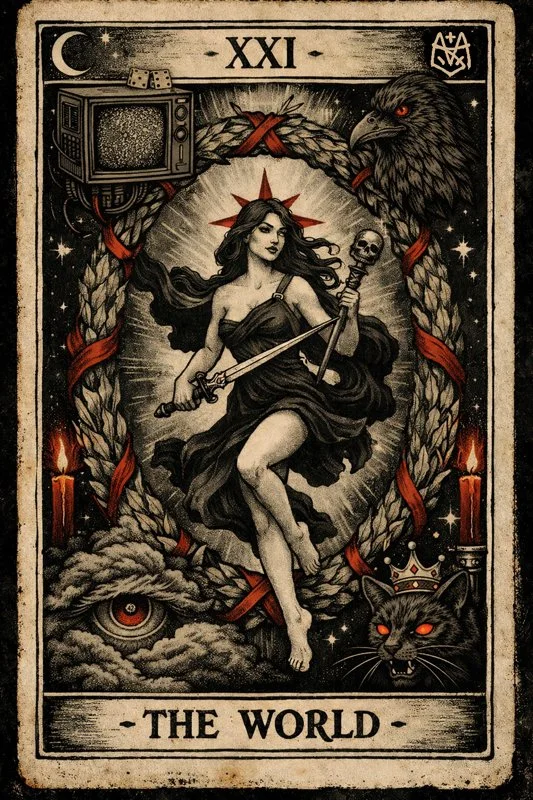
Stranger Things: “Perfect Run” Theory
(Epilogue) | XXI The World
Ok. One last transmission from the Abyss.
If Stranger Things is a loop, then this is the part where you stop grinding the run… and walk out of the room.
I’ve been calling this whole thing a “roguelike” theory for fun: repeating runs, false victories, hidden endings, behavior-based unlocks. Tarot as structure. A story that becomes a game that becomes a mirror.
But the more I played in it, the more I started thinking about the part nobody wants to say out loud:
If the mechanics are real… what are the ethics?
Because let’s be honest.
If a platform can “unlock” story variants through viewing behavior, then it’s not just storytelling anymore. It’s engineering. It’s digital marketing. It’s legal. It’s data. It’s consent. It’s surveillance-adjacent gamification disguised as entertainment.
And yes. That’s brilliant.
It’s also… complicated.
We’ve already seen this move in real life.
Niantic’s Ingress had early adopters mapping traffic patterns and terrain behavior under the banner of play. Google took notice. The tech got bought. Then those maps quietly became the foundation for the next wave of AR games. The players didn’t just play… they built the world.
So… does it matter?
Maybe not to everyone. Maybe only to the ones who remember.
But it asks the question I can’t shake:
Should we have been playing in the first place?
And the scarier cousin of that question:
If we knew the full ramifications, would we still choose to play?
Because this is the paradox of magic.
I discovered the magician Ricky Jay through the documentary, The Deceptive Practices of Ricky Jay. He made mastery look like casual motion, when it was really the product of relentless daily honing. The man could shuffle cards for hours a day, not because it was “useful” but because he made skill beautiful. Even when you know what’s happening, you can still be moved by the mastery.
Advertising works the same way.
When it’s done well, it’s cinematic. Emotional. Elegant. Invisible.
It doesn’t just sell. It converts. It turns you into a believer, convert, acolyte, Fan.
And if the job is flawless… you don’t even notice you’ve been moved. That’s the spell.
But magic has an ethical fork in the road, and it always has:
deception you consent to
vs
deception that quietly collects from you while you clap
There’s an old theft trick called the “quick change scam,” where distraction and rapid exchanges confuse the cashier into handing over too much money. It’s “bad” because it steals. But the sleight-of-hand itself is skilled. Practiced. Technically impressive.
That’s what keeps bothering me.
Because our culture is full of “magic” that quietly takes something from us:
attention
time
belief
money
data
identity
even the memory of why we started watching in the first place
Did I have fun thinking about Conformity Gate? Absolutely.
Did part of me pretend I wasn’t drifting into fandom madness… and simultaneously contributing free marketing to a billion-dollar machine?
Also yes.
So here I am at XXI The World: integration, completion, exit.
I’m not here to debunk anything or accuse anyone, which would ruin the fun.
Just to say: I’m still wrestling with what it means.
42 might be the answer.
But I think I need to go back and figure out what the real question even was.
Either way: massive bravo to everyone involved. Not just the stars, not just the writers, not just production. I’m talking about the people in engineering, digital marketing, product, and legal.
Because if this was a game… it was built like a Mind-Flaying beast.
Until then,
“It is not our abilities that show what we truly are… it is our choices.”
And yeah…
Don’t forget the Joker.
xxx, Viv
P.S. CONFIRMED: SIGNAL BROKE THE STREAM”
"We Broke The Stream."
EXIT PROTOCOL: It’s a strange bit of synchronicity that our debut album,[Elbows Don't Have Eyes], ends with a track called "Epilogue (TBC)." I wrote it long before I started digging into Conformity Gate, but the "TBC aka To Be Continued" energy is identical. If you need a soundtrack for the walk out of the Abyss, [this is the one].