

The “Perfect Run” Theory - EXPANSION
[ Status: System Expanding ]
Stranger Things as a Roguelike
(and why 19/20/21 matters)
// ADVANCE PATH
SYSTEM LOG // MASTER INDEX
Need the full sequence? [Open the Perfect Run Theory overview →]
If Stranger Things is structured like a roguelike, then its “true ending” isn’t in the finale, it’s hidden behind a repeatable viewing pattern, symbolic gates, and the way you choose to play the loop.
This expansion pushes the theory deeper: mapping the series to Tarot’s final arc (XIX → XX → XXI), reframing the aired ending as a polished “false victory,” and suggesting that meaning, or even a different outcome—only emerges through repetition, behavior, and awareness. It’s less about discovering a secret episode and more about recognizing a system: a narrative designed like a game, where completion isn’t just watching everything once, but understanding the pattern, choosing your path, and deciding whether to keep playing.
Ok, hear me out. This is a meta theory, but the structure fits way too well: Stranger Things as a “roguelike” story.
And in roguelikes:
You repeat the same world (“runs”)
You keep failing in new variations
You only unlock the “true ending” through a specific behavior pattern
IF Stranger Things functions like that narratively, then the aired ending can be interpreted as a False Victory/Conformity Ending (aka a happy ending that feels too clean).
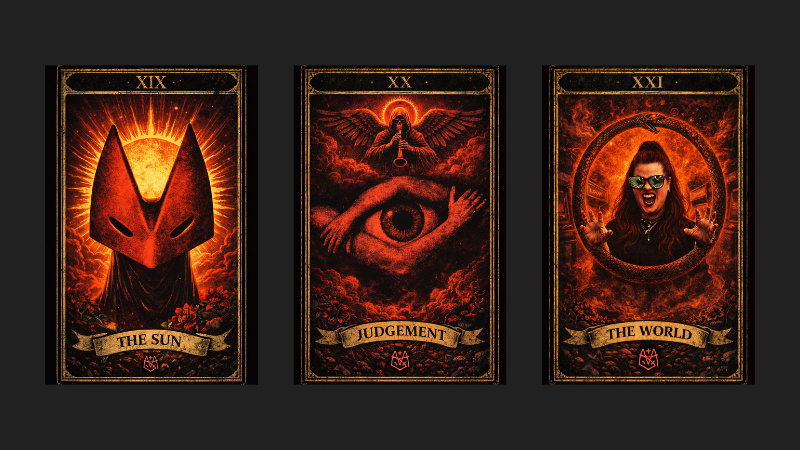
The tarot lens (19 → 20 → 21)
I’ve been studying Major Arcana as storytelling beats, and it maps perfectly:
XIX The Sun = bright/warm/comforting (and potentially blinding)
XX Judgement = awakening/reveal (“seeing behind the curtain”)
XXI The World = true completion/integrated ending (the loop closes correctly)
So:
Finale = XIX
Documentary (“One Last Adventure”) = XX
Which suggests XXI is still unearned/hidden/behind a second gate
The watch-order = “Perfect Run”
[ Future Viv checking in: I need to correct my own math here. I originally mapped the documentary as XX (Judgement), but I was still thinking too linearly. The documentary isn't an ending stage, I now think it's the inflection point. Once you complete the Perfect Run loop, the system forces a branch. The Joker you align with dictates which ending you actually unlock: XX Judgement (the bad ending / loop collapse) or XXI The World (true completion / loop closes).
TL;DR: The game has multiple endings, and the Joker is the selector switch. ]
This is the part I’m curious about:
42 episodes (full series) + documentary + 42 episodes again
Not because it “unlocks” secret content literally (idk…), but because it behaves like a completionist loop. The “Fool’s Journey” is like a designed rewatch mechanic.
The second key (Joker/behavior mechanic)
If Conformity Gate is real and there are multiple possible endings, then we’d need to “unlock” a second gate to choose the variant.
Because in roguelikes, the difference between endings isn’t only where you go… It’s how you play.
I’m pretty sure I cracked the Joker code.
So thank you, Duffers (derogatory + affectionate), for making me do math like this is AP Hellfire Club. I’m not going to spell it out here, because if I’m right… It’s on you to choose the card.
I’ve got you close. Now you just have to run the time-grind loop.
Anyway… I know this sounds insane, but if Stranger Things is a meta-game about loops, trauma, and repeating childhood until you can finally move forward, it’s perfect.
Would love to hear if anyone else has noticed the XIX/XX/XXI structure, or if anyone’s tested weird watch-order patterns.
Until then,
”That's the way I like it, baby
and don't forget the Joker.”
xxx, Viv
ENGINE LOG: I’ve been asked if I’m "over-analyzing" for the sake of the blog. The truth is, these math notes were originally scribbled in the margins of the demos for the upcoming album. The "Perfect Run" isn't just a ST theory—it’s the architecture for how we’re building the next phase of The Stolen Moans.
#MeaningfulCoincidenceMechanics